Radiology's Shortage Is Funded, Not Chosen
Radiology filled 97.6% of 1,478 residency seats in the 2026 Match. The shortage isn't a talent problem. It is a Medicare funding cap.
By Jackie, Beyond the Scan · Last updated: September 16, 2026
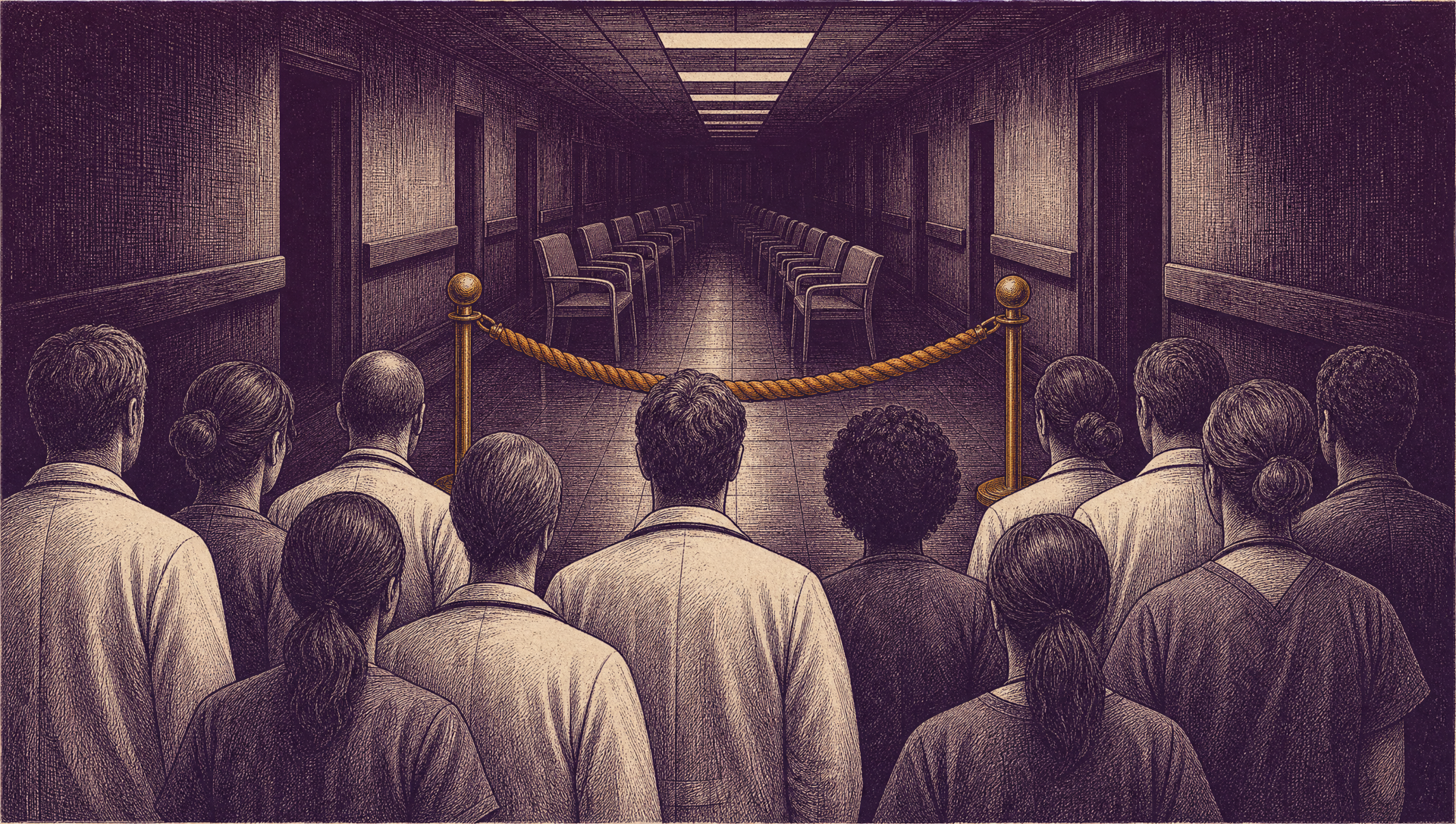
The radiologist shortage is not a shortage of people who want the job. Radiology offered 1,478 residency positions in the 2026 Match and filled 97.6% of them, per the NRMP 2026 Main Residency Match. The number of seats is the constraint, and that number traces to a Medicare funding cap the Balanced Budget Act of 1997 froze at roughly each teaching hospital's 1996 resident count, per CMS Direct Graduate Medical Education rules and the American Hospital Association's 2022 fact sheet. The seats fill. The seats do not multiply. Somebody decided that, and it was nobody in a reading room.
We talk about the shortage the way we talk about weather. The worklists get longer, the night coverage gets thinner, the locum rates climb, and the explanation is always some version of "there just aren't enough radiologists." True. It is also a passive-voice sentence with the subject removed, and the subject is the interesting part.
Why can't radiology just train more radiologists?
Because the lever sits somewhere most of the workforce never touches. Radiology is not begging for applicants; it is turning them away. When people are lined up to provide something the market wants, supply usually expands. Here it does not. A teaching hospital is reimbursed by Medicare for a fixed number of resident positions, frozen hospital by hospital at roughly its 1996 count, per CMS Direct GME rules. It may add residents beyond the cap only by funding them entirely on its own, and for most programs that math does not work. A department chair cannot decide to train 10 more residents next year the way a practice can decide to hire 10 more attendings. The funded seats are not theirs to create.
What did the 1997 Balanced Budget Act actually do?
It solved a problem the country turned out not to have. The cap answered a 1990s worry that America was producing too many doctors, per the American Hospital Association's 2022 fact sheet on graduate medical education. The fix was elegant in the way budget fixes usually are: take a snapshot of who happened to be training where in 1996, and pay for that, forever. The snapshot froze the geography along with the number, so a fast-growing metro in 2026 does not get more funded seats because its need went up. It gets the seats 1996 assigned it. The law is older than most of the residents training under it.
Has Congress ever raised the cap?
Once, meaningfully, and modestly. The Consolidated Appropriations Act of 2021, Section 126, added 1,000 Medicare-funded residency slots, the first real increase since 1997, phased in at no more than 200 per year from fiscal 2023 across five annual rounds, the last closing March 31, 2026, per the CMS Section 126 FAQ and the AAMC. Spread across every specialty in American medicine, 200 seats a year is a rounding error applied to a 25-year freeze. It is the policy equivalent of tipping a dollar on a tab you have been running since the Clinton administration. The AAMC projects a national physician shortage of 13,500 to 86,000 by 2036 and says plainly that lifting the cap would ease, though not eliminate, the gap, per its March 2024 report. Ease, not eliminate.
Didn't residency positions grow anyway?
They did, and this is where the story gets better than "the cap froze everything." Radiology residency positions grew 33% between 2010 and 2025, from 1,090 to 1,449. But the practicing workforce grew only 12%, to 38,306, and supply moved from 11.1 to 11.5 radiologists per 100,000 people between 2010 and 2022, per Malhotra and colleagues in the Journal of the American College of Radiology, 2026. A third more seats bought four tenths of a radiologist per 100,000 Americans. Attrition, retirement, and the years between matching and reading independently absorb most of any gain, so the seats added today are a bet on the reading rooms of the mid-2030s.
Who benefits from calling it a "shortage"?
Language does work, and "shortage" does a specific kind. It is a noun that describes a condition and names no cause, which makes it perfect for a system that would rather not discuss causes. A shortage is something that happened. A cap is something somebody wrote. Say "shortage" often enough and the freeze disappears behind the weather report, and the pressure lands on the person reading 80 studies a shift. The explanations on offer are always about people: interest is fading, AI is scaring them off. The applicant pool did decline, down about 14% from its 2023 peak of 2,014 to roughly 1,741 in the 2026 cycle, per NRMP historical applicant data. And still the seats filled. The funded ceiling sits so far below demand that even a smaller pool overwhelms it. Young physicians still want the work, in numbers the system cannot seat. The constraint is a formula.
What does this mean for the people inside the reading room?
This does not shorten your worklist. It relocates the pressure. The shortage on your shoulders is not evidence that the field failed to attract talent, or that you personally should out-endure it. The applicants are there. The seats they could have filled were never funded into existence. When a shortage is framed as weather, the people inside it absorb it as an individual burden. Framed accurately, as a constraint that policy built and policy can adjust, it becomes a choice. Not one any radiologist made, but one the system keeps making every year the cap stays put. "There aren't enough radiologists" is where the conversation usually ends. The more useful sentence starts one layer down. There aren't enough funded seats to train the radiologists who already want the job. That is not weather. Someone wrote it down.
Frequently asked questions
Did the 1997 Balanced Budget Act cause the radiologist shortage?
Not alone, but it is the central supply-side cause. The Balanced Budget Act of 1997 capped the residency positions Medicare will fund, freezing each teaching hospital near its 1996 resident count, per CMS Direct GME rules and the American Hospital Association's 2022 fact sheet. That cap limits how many new radiologists the system can produce each year, regardless of applicant interest.
Is radiology hard to get into, or is nobody applying?
Radiology is highly competitive. In the 2026 Match it filled 97.6% of the 1,478 positions offered across diagnostic and interventional radiology, even as the applicant pool fell about 14% from its 2023 peak of 2,014 to roughly 1,741, per NRMP 2026 Match results and historical applicant data. Demand is outstripping a capped pipeline, not weak interest.
Has the Medicare residency cap ever been raised?
Yes, modestly. The Consolidated Appropriations Act of 2021, Section 126, added 1,000 Medicare-funded slots, the first meaningful increase since 1997, phased in at no more than 200 per year from fiscal 2023 across five annual rounds, per the CMS Section 126 FAQ and the AAMC. Spread across every specialty, the additions are small against the projected need.
Would lifting the cap fix the shortage?
It would help. The AAMC projects a U.S. physician shortage of 13,500 to 86,000 by 2036 and says lifting the federal GME cap would ease, though not eliminate, the gap, per its March 2024 report. Radiology positions grew 33% from 2010 to 2025 while the practicing workforce grew 12%, per Malhotra and colleagues in JACR, 2026, so attrition and training lag matter too.
Sources: NRMP, 2026 Main Residency Match results and historical applicant data; CMS, Direct Graduate Medical Education and the Section 126 FAQ; American Hospital Association, GME fact sheet, 2022; AAMC physician shortage report, March 2024; Malhotra A, et al., "The Evolving US Radiologist Pipeline," JACR 2026;23(8):1587-1592. Verified as of September 2026.