The Decade We Spent Bracing for a Replacement That Never Came
The 2016 "AI will replace radiologists" prediction was wrong. The fear it created reshaped a generation's careers anyway. What the wrong call cost.
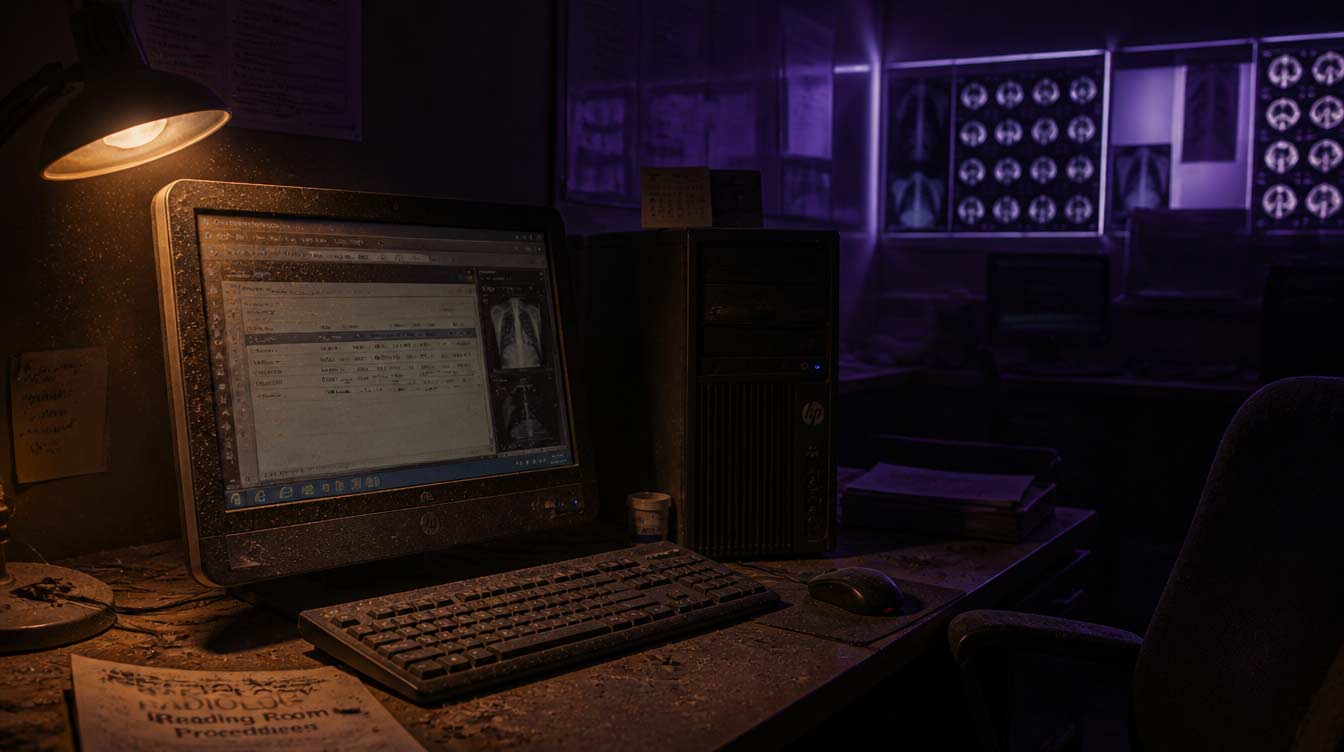
There is a fourth-year medical student somewhere right now, doing the thing they have been quietly told not to do. They are sitting with the radiology specialty page open in one tab and a decade of secondhand warnings open in their head. They like the work. They like the puzzle of it, the way a study resolves into a story. And a small, well-trained voice keeps interrupting to ask whether they are about to train four extra years for a job a machine is going to finish before they do.
That voice did not come from nowhere. It was installed, carefully, in 2016, when a leading figure in machine learning stood in front of a room and said the quiet part as a forecast: stop training radiologists now, because within five years deep learning will do it better, and anyone still in the pipeline is training for a profession that will not exist.
It is 2026. The five years came and went, then five more. The profession exists. It is, by almost every measure that matters, more in demand than it was when the prediction was made. And yet the student in that scene is real, and the hesitation is real, and that gap between what happened and what people still feel is the whole subject here.
The forecast got a louder microphone than the follow-up
Predictions in technology have a strange afterlife. The bold one travels. It gets quoted at dinner parties and embedded in advising conversations and repeated by people who could not name a single FDA-cleared tool. The correction, when it comes, travels in a wheelchair. It is technical, it is hedged, it shows up in a workforce journal nobody reads at a cocktail party.
So here is the correction, stated plainly, because it earned a louder voice than it ever got. The number of FDA-cleared radiology AI devices crossed roughly 1,000 by the end of 2023 and stood above 1,039 by the end of 2025. Radiology accounts for the large majority of all FDA AI medical-device authorizations granted since 1998. By any honest reading, the technology arrived. It arrived harder and faster in radiology than anywhere else in medicine.
And the radiologists did not leave. Over the same window in which the field was supposedly being automated out of existence, one large academic system grew its radiologist headcount by roughly 55 percent. The U.S. Bureau of Labor Statistics projects radiology employment growing meaningfully faster than the average occupation, not slower. The tools that were supposed to be the eviction notice turned out to be a way to read more studies in a day that already had too many in it.
If you want the cleanest version of the irony: the technology hit something close to full saturation in the reading room, and hiring went up anyway. The machine did the thing it was supposed to do. The replacement simply was not part of the deal.
What the prediction was actually measuring
I used to think the 2016 prediction was just wrong about the technology, a timeline miss, the kind of thing every forecaster is allowed a few of. The longer I sat with it, the less that explanation held. The prediction was not really a claim about software. It was a claim about what radiologists do, and that is where it fell apart.
It modeled the radiologist as a pattern detector. Image in, finding out, and if a model can label the finding, the human is redundant. But the detection was never the whole job, or even the hard part of it. The hard part is the judgment around the finding. Is this incidental or is this the thing. What does it mean against this patient's history, this clinical question, this conversation with a worried referring physician at 7 p.m. A model that flags a nodule has not done that work. It has done the first ten seconds of it and handed the radiologist the next thirty years of liability and meaning.
So the prediction was not too optimistic about AI. It was too pessimistic about people, in the specific way that confident forecasts often are. It mistook the most legible part of a job for the entire job, because the legible part is the part you can put on a slide.
The fear was the product, and it shipped on time
Here is the part that does not get said enough. Even though the prediction was wrong, it was not harmless. It shipped one thing exactly on schedule, and that thing was the fear.
You can see the fear in the pipeline. The number of PGY-1 diagnostic-radiology applicants has fallen to roughly 1,741, down about 14 percent from the 2023 peak of 2,014. That is three years of contraction in the pool of people choosing to start, and uncertainty about AI's effect on the field is named, repeatedly, as one of the reasons. Meanwhile the specialty itself fills nearly every seat it offers, year after year. The demand is not in question. The hesitation upstream is.
Read those two facts next to each other and the shape of the cost becomes clear. This was never going to show up as radiologists losing their jobs, because that was the prediction that failed. It shows up one level earlier, in the people who quietly decided not to become radiologists at all. A generation made a high-stakes, decade-long career decision partly in the shadow of a forecast that the data was, even then, busy refuting.
And the people who absorbed the fear most completely were never the senior attendings with a practice and a mortgage and a reputation. It was the residents and the medical students, the ones with the least information and the most runway, the ones for whom a confident sentence from a famous expert lands like a weather report rather than a guess. They did the responsible thing. They listened to the expert. The expert was wrong, and they are the ones who carried it.
The hype cycle has a customer, and it is not the radiologist
It would be comforting to treat 2016 as a one-time error we have all since outgrown. We have not. The replacement narrative just changed clothes. It is no longer "AI will replace radiologists." It is sleeker now, something about autonomous reads and the inevitable end state, and it shows up on conference stages and in pitch decks with the same confident cadence and the same five-year horizon that keeps politely sliding forward.
There is a reason the narrative is durable, and it is not that it keeps coming true. Replacement is a good story. It sells conference tickets and headlines and the occasional funding round. The quiet, true version, that these tools mostly help an overloaded human do more of a job there are not enough humans to do, sells none of those things. So the loud version keeps getting the microphone, and the radiologists keep getting the homework of explaining, again, that the thing flagging the nodule did not also call the patient.
The honest framing was available the entire time. The tools are real, they are useful, and they are arriving inside a workforce that is stretched thin by volume growing faster than the pipeline can fill. That is not a replacement story. That is an amplifier handed to people who are already underwater. It is a less dramatic sentence. It also happens to be the true one.
What it cost, and what is still being decided
So what did the decade of bracing actually buy. Not layoffs, the data is unambiguous there. It bought hesitation, at the exact upstream point where the field could least afford it. It bought a smaller pool of people willing to start, in a specialty already constrained by a residency pipeline capped by federal funding rather than by interest. It bought a generation of advising conversations that opened with a hedge instead of an invitation.
The student in the first scene is still sitting there. That is the part worth ending on, because that part is not settled. The prediction is decided. The data is in, the replacement did not come, and ten years of hiring closed the case. What is still open is whether the fear it manufactured gets to keep making decisions on its behalf, long after the thing it warned about failed to show up. Somebody should tell the student that the scariest sentence they ever heard about this field was a forecast, and that the forecast already lost.
More at beyondthescan.io.